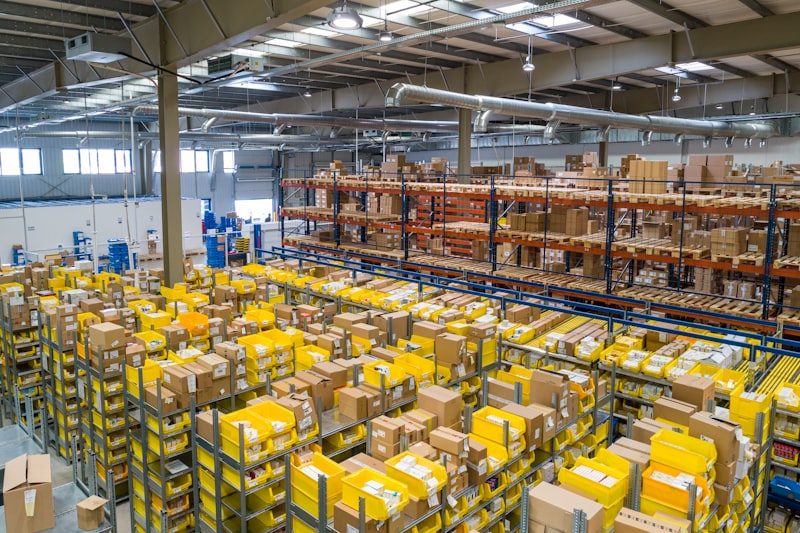
Why Supply Chain Is Now AI's Highest-ROI Enterprise Application
Supply chain and logistics operations generate enormous volumes of structured, time-stamped data — the exact input that machine learning models consume most effectively. Demand signals, inventory levels, transit times, supplier lead times, weather data, and macroeconomic indicators can all be fused into predictive models that dramatically outperform human planners operating on intuition and spreadsheets. According to Gartner's 2024 Supply Chain Technology User Wants and Needs Survey, AI and machine learning ranked as the top technology investment priority for supply chain leaders for the third consecutive year. The business case is equally clear: McKinsey estimates AI applications in supply chain management can reduce logistics costs by 15%, improve inventory levels by 35%, and cut service delivery times by 65%.
The 6 AI Use Cases with Proven Supply Chain ROI
1. Demand Forecasting
Traditional demand forecasting relies on statistical methods like moving averages and exponential smoothing, which cannot incorporate unstructured signals (social media sentiment, competitor promotions, news events). ML-based demand forecasting — using gradient boosting or LSTM neural networks — typically reduces mean absolute percentage error (MAPE) by 20–50% compared to statistical baselines. For a distributor with $50M in annual inventory carrying costs, a 25% reduction in MAPE translates to roughly $3–5M in annual inventory savings. Implementation timeline: 3–5 months for a production-ready forecasting system with full data pipeline integration.
2. Route Optimization and Last-Mile Delivery
AI route optimization engines — combining reinforcement learning with real-time traffic, vehicle capacity, and time-window constraints — consistently outperform legacy routing software by 10–20% on cost per delivery. UPS's ORION system, one of the earliest large-scale deployments, saved the company over $400 million annually. Modern cloud-based AI routing tools have made this capability accessible to mid-sized fleets. A fleet of 50 vehicles completing 200 deliveries per day can expect to save 8–15% on total fuel and driver costs within 90 days of deployment.
3. Warehouse Automation and Slotting Optimization
AI-powered warehouse management systems analyze historical pick frequencies, order co-occurrence patterns, and seasonal demand shifts to continuously reoptimize product placement (slotting). Properly implemented AI slotting reduces average pick travel distance by 15–30%, directly increasing labor productivity. Combined with computer vision for quality control and robotics orchestration, AI-enabled warehouses operate at 2–4× the throughput of traditional facilities with comparable footprints.
4. Supplier Risk and Lead Time Intelligence
NLP models trained on news feeds, financial reports, social media, and customs data can identify supplier financial distress, geopolitical disruptions, and port congestion 4–8 weeks earlier than traditional procurement monitoring methods. Early supplier risk detection prevents expediting costs, which average 5–10× the cost of planned procurement. DigitalHubAssist's LogisticHubAssist practice deploys a supplier intelligence layer that monitors over 200 external data signals per supplier, providing weekly risk scores to procurement teams.
5. Predictive Maintenance for Fleet and Equipment
IoT sensor data from vehicles and warehouse equipment — vibration, temperature, fuel consumption, brake usage — fed into anomaly detection models enables maintenance scheduling based on actual equipment condition rather than fixed time intervals. This shift from preventive to predictive maintenance reduces unplanned downtime by 30–50% and total maintenance costs by 10–25%. For a logistics company operating 100 vehicles, eliminating 2–3 unplanned breakdowns per month can save $150,000–$300,000 annually in emergency repairs and missed delivery penalties.
6. Automated Freight Audit and Invoice Processing
Large shippers receive thousands of carrier invoices monthly. Manual audit catches only 30–40% of billing errors; AI-powered freight audit systems achieve 95%+ accuracy and process invoices in seconds rather than days. Industry benchmarks indicate that 3–8% of freight invoices contain errors in the shipper's favor. Automated audit with AI typically pays for itself within the first 60–90 days of deployment.
Supply Chain AI Implementation: A Realistic Timeline
| Phase | Duration | Key Activities | Milestone |
|---|---|---|---|
| Data Audit & Readiness | Weeks 1–4 | Inventory data sources, quality assessment, gap analysis | Data readiness score and integration map |
| Use Case Prioritization | Weeks 3–6 | ROI modeling, feasibility scoring, stakeholder alignment | Signed-off business case with KPI targets |
| Data Pipeline Build | Weeks 5–12 | ETL pipelines, data warehouse/lake setup, feature engineering | Clean, labeled training dataset |
| Model Development & Testing | Weeks 10–18 | Model training, backtesting, A/B testing vs. baseline | Model outperforms baseline by target margin |
| Production Integration | Weeks 16–22 | API integration with ERP/WMS/TMS, user training | Live predictions flowing to planning systems |
| Monitoring & Optimization | Ongoing | Model drift detection, retraining, continuous improvement | Monthly KPI review against baseline |
How to Calculate Your Supply Chain AI ROI Before You Invest
Use this framework to build a preliminary business case. Identify your highest-cost supply chain pain points and apply conservative improvement estimates:
- Inventory carrying costs: Annual carrying cost × 25% improvement estimate = annual savings potential
- Logistics and transportation spend: Annual spend × 12% efficiency improvement = annual savings potential
- Stockout cost: Estimated annual lost revenue from stockouts × 40% reduction = revenue recovery
- Manual processing labor: FTEs × loaded cost × 60% automation rate = labor savings
A mid-sized distributor with $200M in revenue can typically identify $3–8M in annual savings potential from a prioritized AI implementation roadmap. Implementation costs typically run $300,000–$800,000 for a comprehensive supply chain AI deployment, yielding a 2–3 year payback period and 5-year ROI of 400–900%.
Frequently Asked Questions
What data do I need to start with AI in my supply chain?
The minimum viable dataset for demand forecasting is 24 months of daily sales or order history at the SKU-location level, with at least 80% completeness. For route optimization: vehicle capacity constraints, historical delivery addresses, and time-window requirements. For predictive maintenance: 12+ months of sensor readings from vehicles or equipment. Data does not need to be perfect to start — a phased data quality improvement plan is part of any credible AI consulting engagement.
Can small and mid-sized logistics companies afford AI implementation?
Yes. The cost of supply chain AI has dropped dramatically since 2020. Cloud-native ML platforms (AWS SageMaker, Google Vertex AI, Azure ML) have eliminated the need for on-premise hardware investment. A focused demand forecasting deployment for an SMB distributor can be delivered for $75,000–$150,000 with a 9–15 month payback period. LogisticHubAssist offers modular engagements designed specifically for companies with $20M–$500M in annual logistics spend.
How long before I see results from supply chain AI?
Quick wins — such as automated freight audit and invoice processing — can show measurable ROI within 60–90 days. Demand forecasting improvements are typically visible within the first full forecast cycle after go-live (usually 30–60 days). Route optimization ROI is often measurable in the first week of live deployment. Full-scale transformation ROI — including inventory optimization and supplier intelligence — compounds over 12–24 months as models train on more production data.
What is the biggest risk in supply chain AI projects?
The single biggest risk is poor data quality combined with over-ambitious scope. Teams that attempt to solve five supply chain problems simultaneously with a single AI platform almost always underdeliver. The correct approach is to identify the one use case with the clearest data foundation and highest immediate ROI, deploy it to production, learn from real-world performance, and then sequence the next use case. DigitalHubAssist's LogisticHubAssist methodology enforces this sequencing discipline through its staged deployment framework.
Do I need to replace my existing ERP or WMS to implement AI?
No. AI models are typically deployed as a layer that sits alongside existing ERP and WMS systems, consuming their data via API or database connector and feeding predictions back into planning and execution workflows. The vast majority of supply chain AI deployments are additive, not replacement projects. Integration complexity depends on the age and API maturity of your existing systems — a detailed technical assessment in the first phase of any engagement will quantify integration effort precisely.